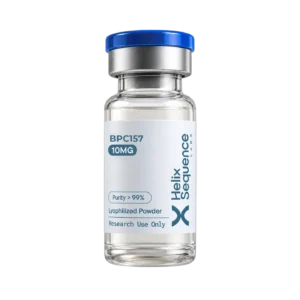
BPC-157 has been studied across preclinical models, skin wounds, tendon fibroblasts, GI lesions, and muscle injury, with researchers reporting effects on angiogenesis, collagen deposition, cell migration, and signaling pathways including VEGF, FAK/paxillin, and ERK1/2.
Research Areas
Wound Healing: More collagen, blood vessels & reepithelialization (5,6)
Tendon Healing: Fibroblast migration & outgrowth via FAK/paxillin (1)
GI Healing: Consistent results across esophagus to lower GI tract
Tissue & Organ Effects: Studied in pancreas, liver & heart models (8)
Muscle Healing: Restored function in corticosteroid-damaged muscle
Notice
Findings summarized from published preclinical (animal and in-vitro) research, not human clinical trials. Not evaluated by the FDA. For laboratory research use only — not for human or veterinary use.
Higher collagen, reticulin & vessel density vs. control.
In a study, three experimental murine models were used – first with skin tissue wounds, second with colon tissue anastomosis, and third with synthetic sponge implantation. A portion of the murine models were presented with a placebo, whereas others were presented with the BPC 157 peptide. After the study, all models were histologically examined. The researchers reported that the BPC-157 murine models appeared to exhibit higher numbers of collagen, reticulin, and blood vessel development than the ones in the control group.(5)
In a particular study, researchers explored the theory that the peptide BPC-157 might potentially hasten wound healing compared to a control group. This hypothesis was rooted in observing possible improvements in several key areas of wound healing. These included the formation of new granulation tissue, which is critical in the healing process, along with reepithelialization. In this process, new epithelial cells form to replace those damaged by the wound. Additionally, there was an observation of potential improvements in dermal remodeling, a phase where the skin regains strength and elasticity, and collagen deposition, crucial for tissue repair.(6)
Increased VEGF-a; faster vascular tube formation, in vitro.
In a study, three experimental murine models were used – first with skin tissue wounds, second with colon tissue anastomosis, and third with synthetic sponge implantation. A portion of the murine models were presented with a placebo, whereas others were presented with the BPC 157 peptide. After the study, all models were histologically examined. The researchers reported that the BPC-157 murine models appeared to exhibit higher numbers of collagen, reticulin, and blood vessel development than the ones in the control group.(5)
In a particular study, researchers explored the theory that the peptide BPC-157 might potentially hasten wound healing compared to a control group. This hypothesis was rooted in observing possible improvements in several key areas of wound healing. These included the formation of new granulation tissue, which is critical in the healing process, along with reepithelialization. In this process, new epithelial cells form to replace those damaged by the wound. Additionally, there was an observation of potential improvements in dermal remodeling, a phase where the skin regains strength and elasticity, and collagen deposition, crucial for tissue repair.(6)
Regulated ERK1/2 phosphorylation & downstream targets.
Wound Healing
In a study, three experimental murine models were used – first with skin tissue wounds, second with colon tissue anastomosis, and third with synthetic sponge implantation. A portion of the murine models were presented with a placebo, whereas others were presented with the BPC 157 peptide. After the study, all models were histologically examined. The researchers reported that the BPC-157 murine models appeared to exhibit higher numbers of collagen, reticulin, and blood vessel development than the ones in the control group.(5)
In a particular study, researchers explored the theory that the peptide BPC-157 might potentially hasten wound healing compared to a control group. This hypothesis was rooted in observing possible improvements in several key areas of wound healing. These included the formation of new granulation tissue, which is critical in the healing process, along with reepithelialization. In this process, new epithelial cells form to replace those damaged by the wound. Additionally, there was an observation of potential improvements in dermal remodeling, a phase where the skin regains strength and elasticity, and collagen deposition, crucial for tissue repair.(6)
Increased fibroblast migration via FAK/paxillin pathway.
Consistent healing from esophagus to lower GI tract.
99.9% purity · COA included
$30.00
Save from 3+ · As low as $25.50/vial
View OptionsFor the investigator
Every overview below is the same technical language used on each product's certificate of analysis — batch traceability and purity data are reachable here without an account or a sales conversation.
For the optimizer & the practitioner
Research summaries are written from published studies, not marketing copy — hedged the way the underlying papers hedge. Dosing and safety documentation live separately from any promotional content.
 Third-Party Tested
 99%+ pure peptides
 USA Tested
 cGMP Manufacturing
 Affordable Pricing
All compounds listed on this page are sold as reference materials for laboratory research use only. They are not drugs, dietary supplements, or cosmetics, and are not intended for human or veterinary use, diagnosis, treatment, or prevention of any disease. Applications must be conducted by qualified professionals in controlled laboratory environments. Product availability is subject to age verification and geographic restrictions at checkout.
Certificates of analysis for every batch are available in the COA Library without creating an account.
Product Finder
Two quick questions route you to the compound most aligned with your research focus, plus what's commonly studied alongside it.
For research routing only, not a medical assessment. All compounds are sold for laboratory research use only.
Question 1 of 2
Pick the pathway closest to your current work, you can browse the rest anytime.
Question 2 of 2
Helps us tailor which compound and guidance we lead with.
Your Results
Your Research Pathway
Primary Recommendation
Retatrutide
Engineered to interact with GLP-1, GIP, and glucagon receptor systems.
Often Studied Alongside
Complementary research pathways
Based on what you've told us, most independent researchers start with a single vial before scaling up.